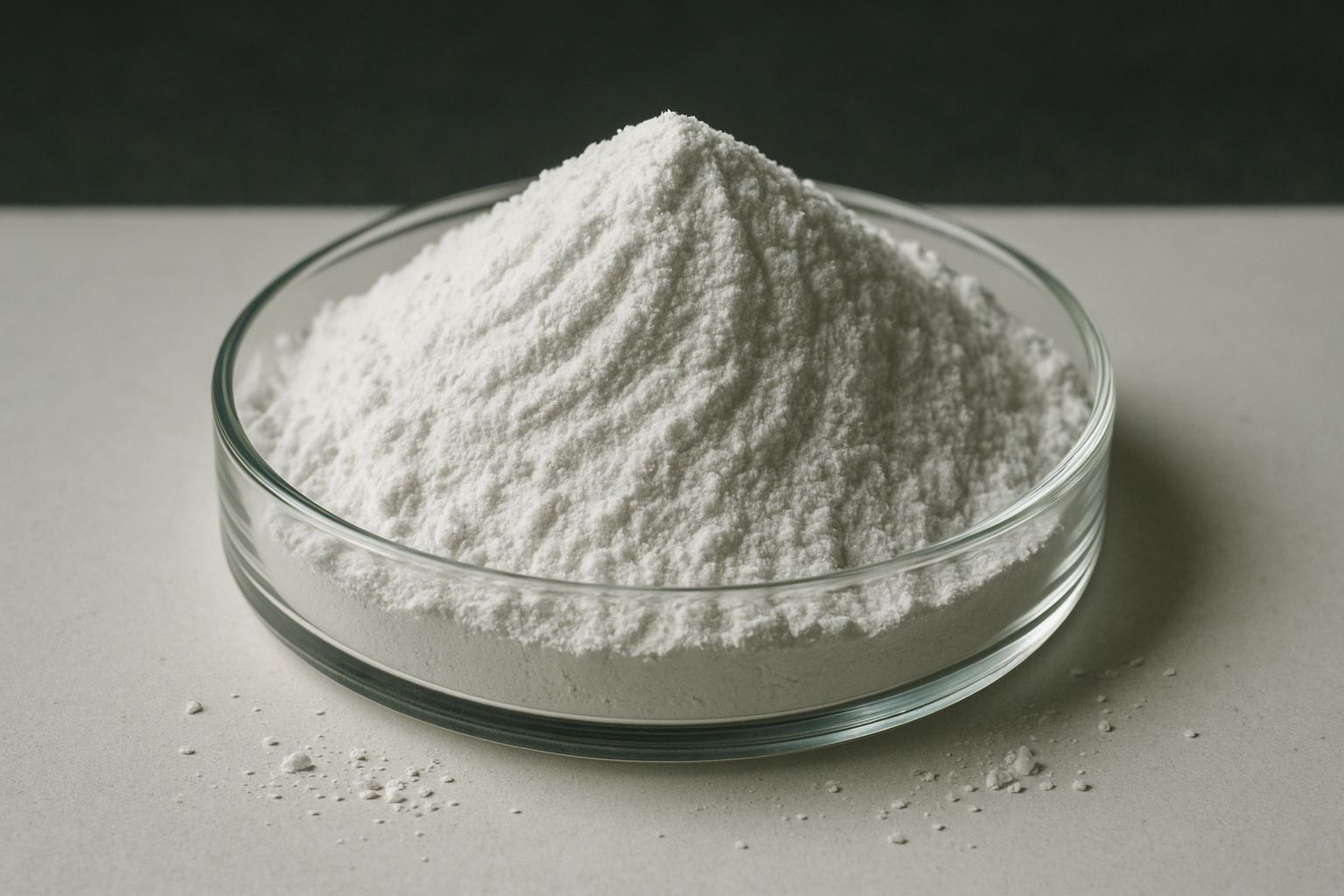
Zinc oxide is the filter the natural category is built on, and it is a more interesting material than the marketing allows. It is not inert, it is not simple to work with, and its main optical virtue is the one least often mentioned.
What it is
Zinc oxide is a white inorganic solid, formula ZnO, which normally adopts the wurtzite crystal structure. Cosmetic grades are manufactured rather than mined, usually by vaporising zinc metal and oxidising the vapour in air, then classifying and milling the powder to a controlled particle size distribution and applying a surface treatment. The treatment matters as much as the particle: coatings of silica, alumina, silicone materials or fatty acid salts control how readily particles clump, how they wet into an oil phase, and how much they interact with everything else in the tube.
It has a very long history in skin preparations, considerably longer than its use as a sunscreen filter, and it is familiar from calamine and from barrier creams. That familiarity is part of why it carries a reassuring reputation, and the reputation is not misplaced. It is simply not the same thing as the mechanism story usually attached to it.
Zinc oxide
Zinc oxide; Zinc oxide (nano) is a separate entry with its own conditionsA wide band gap inorganic semiconductor, wurtzite structure, supplied as a surface treated powder or as a pre dispersed suspension in oil or water.
Absorbs ultraviolet across its band gap, with an absorption edge near the ultraviolet A to visible boundary. Gives the most even long wave ultraviolet A coverage of any single permitted filter.
Lower absorbance per unit mass than titanium dioxide in the ultraviolet B, so high factors need heavy loading. Amphoteric, so it interacts with acidic ingredients and shifts formulation pH. Prone to agglomeration.
Behaviour of released zinc species in aquatic environments at realistic concentrations; the extent to which coatings survive a product's shelf life and its time on skin.
The optics, properly stated
Zinc oxide is a semiconductor with a band gap in the ultraviolet. A photon with energy above the gap promotes an electron from the valence band to the conduction band and is absorbed. A photon with less energy passes through. Because the gap corresponds to a wavelength near the edge of the visible, zinc oxide absorbs across essentially the whole ultraviolet range that reaches the ground, including the long ultraviolet A that most small organic filters struggle with.
That is its genuine and distinctive advantage. Almost nothing else on the permitted list gives such flat coverage at the long end. Formulations built on zinc oxide tend to have good intrinsic ultraviolet A performance for that reason, though intrinsic absorption still has to be converted into measured protection by a film that actually covers.
Alongside absorption, zinc oxide particles scatter light. Scattering depends on the ratio of particle size to wavelength and on the refractive index contrast with the surrounding medium. Zinc oxide's refractive index is high compared with the oils around it, though lower than titanium dioxide's, which is one reason it is less brutally whitening at a comparable particle size. Reduce the particle size far enough and visible scattering collapses while ultraviolet absorption persists, which is the entire basis of transparent mineral formulations and the subject of particle size.
Zinc oxide is a physical barrier that sits on the skin and blocks the sun
- What would have to be true
- That the dominant mechanism is a physical obstruction of radiation rather than absorption of it.
- That a zinc oxide film behaves as a continuous barrier rather than as a distribution of discrete particles.
- What is established
- Zinc oxide attenuates ultraviolet principally by absorbing it across the semiconductor band gap.
- A metal oxide film is a layer of discrete particles whose protection depends on how completely they cover the surface, which is why quantity applied has such a large effect.
- What is not established
- That the barrier picture explains the protection.
- That a zinc oxide layer is continuous at the scale that matters, or that it blocks rather than absorbs.
What it does to the rest of the formula
This is where zinc oxide stops being simple. It is amphoteric: it reacts with both acids and strong bases. In a cosmetic that means several things at once.
- It raises pH. Zinc oxide in water produces a mildly alkaline environment. Ingredients that need an acidic pH to remain stable or effective will not be happy alongside it.
- It reacts with acidic actives. Carboxylic acid functionality in a formula can form zinc salts. The result may be a thickened, grainy or separated product, and the active is no longer what it was.
- It destabilises emulsions. Particulate solids at an oil and water interface change how that interface behaves. Zinc heavy emulsions frequently need specific emulsifier systems and rheology modifiers that a comparable organic filter emulsion would not.
- It affects preservation. A raised pH changes the efficacy window of several preservative systems, which has to be verified rather than assumed, and preservative efficacy testing is a requirement of the safety assessment.
- It settles. A dense inorganic powder suspended in a fluid wants to sediment. Suspension has to be engineered, and a product that separates on the shelf is not delivering the filter loading its label implies.
None of that is a criticism. It is the reason a good zinc formulation represents real formulation skill, and the reason a poor one feels like wet sand.

Why zinc formulations use so much filter
Zinc oxide's absorbance per unit mass is modest compared with the strongest organic filters and lower than titanium dioxide's in the ultraviolet B. To reach a high labelled sun protection factor with zinc oxide alone, a formulator needs a high loading. A high loading of solid particles is heavy, it drags on application, it whitens, and it consumes the formula's capacity for emollients that would have made it pleasant.
That is the central trade off of the mineral category, and it is a physical constraint rather than a failure of effort. It is examined further in why mineral formulations are hard to make elegant.
What zinc oxide is not
It is not inert. It participates in acid base chemistry, it can catalyse reactions at its surface under irradiation, and it slowly releases zinc species in aqueous media. Cosmetic grades are coated partly to control this.
It is not naturally occurring in the form used. The mineral zincite exists, and it is not the source of the material in your sunscreen.
It is not automatically safer than an organic filter, and it is not automatically gentler. Those claims are dealt with in the skin section, where the evidence is thinner and more interesting than either side of the argument tends to admit.
Zinc oxide appears on the permitted list both in conventional form and as a nanomaterial, with distinct conditions attached to the nano entry. Where a nanomaterial is present, the ingredient list must identify it. What that labelling does and does not tell you is set out in the article on nano and non nano labelling.
Zinc as a nutrient, and why that is a separate question
Zinc is an essential trace element and appears in dietary guidance, which occasionally leads to the suggestion that a zinc based sunscreen is therefore nourishing skin. That does not follow. Dietary zinc and a coated zinc oxide particle sitting in a film on the stratum corneum are different propositions, and the relevant question for a sunscreen filter is dermal penetration, not nutrition. The available assessment work has consistently found that intact skin is a substantial barrier to these particles. Questions about zinc intake, deficiency or supplementation are nutrition and clinical matters, and belong with a GP, a pharmacist or the NHS rather than with a sunscreen article.
Nothing here is advice about a supplement, a diagnosis or a skin condition. If you are considering zinc supplementation, or you have a skin condition that changes what you can put on your skin, ask a pharmacist or your GP. The NHS pages on vitamins and minerals are a reasonable starting point.
The position, stated fairly
Zinc oxide is a good filter with a distinctive strength, real formulation difficulty, and a reputation that outruns the evidence in one direction while underselling its actual advantage. If you want even long wave ultraviolet A coverage from a single filter, it is the best thing on the list. If you want a weightless finish at a very high factor, physics is against you.